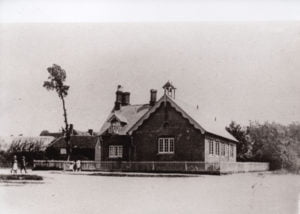
I started at Wilstone village school in 1952 at age 4. My mum had gone to the same school in the mid 1920’s, leaving at age 14 as was normal back then. It had not changed very much since mum’s time. It was a very solid brick building from the 1800’s which included teacher accommodation. There were two classrooms and an entrance hall/cloakroom. Separate boys’ and girls’ toilets were on the edge of the large asphalt surfaced playground.
Wilstone school had less than 30 children in the early 1950’s meaning there were only about four or five children for each year, girls and boys. Some of the children I remember from the first few years at school: Michael Bishop, David Brackley, Eileen Cook, Kenny Dover, Lois Edwards, Martin Hill, Dennis Horne, Judy Kimber, Stuart Milton, Keith Pegg and Michael Robinson. Older than me and leaving to go to Mortimer Hill school in Tring at age 11, I remember: Linda Bishop, Andy Edmunds, Arthur Horne, Rex Jeffrey and his brother Colin, and Sandra Reeves. Some of the village’s more affluent children went to private schools. My friend Gerald Wilkins, went to Osmington school in Tring, for example.
There were two teachers at the school: Mr Bromhead and his wife. Mr Bromhead taught the older children while his wife taught the younger ones for three or four years before passing them along to her husband in the senior class. To a 4-year old, Mrs Bromhead was a very daunting woman. However, she did teach me the 3Rs. In passing let me say that I am not aware of anyone who left Wilstone school unable to read or write. The playground was used for PE and maypole and other forms of country dancing. We often played rounders.
At about the same time as I progressed from the junior form to the seniors, Mrs Bromhead left the school and was replaced by Mrs Silson. Mrs Silson and her husband took over the accommodation at the school. Mr Bromhead and his wife moved to Buckland. Mr Bromhead began coming to school each day on a motorcycle.
The size of the class and the fact that a few new members arrived from the juniors each year while a few left for secondary school, meant that rather than getting four or five years of teaching, each child got one year of teaching repeated four or five times.
Break times were spent in the playground. Some of the games I remember included: cowboys and indians, doctors and nurses, tag, What’s the Time Mr Wolf and ‘Kiss Chase’. The latter was a mystery to me and the rules were not clear. It seemed to be more popular with some of the older girls. Younger boys tended to play football or cricket. No girls were allowed. There were sometimes fights in the playground. I was involved in some of them.
There was a certain amount of bullying of the younger boys by the older boys, which was accepted as ‘normal’. There was a kind of initiation ceremony for younger ones. Some, not all, older boys would punch a boy in the midriff to cause winding. This action was presented by the older boys as an important life lesson to us not to get punched in the midriff; they were very proud of themselves.
On the more positive side every year the school would put on a Nativity play of some kind. And there were other types of theatrical performances too. And looking back it seems obvious that Mr Bromhead enjoyed putting on these shows. He was certainly very good at it. The children certainly had a lot of fun.
The school also arranged outings. I am not sure how often that happened. I only recall three or four. Transport was always an issue. In 1953, age 5, the whole school and I walked the two and a half miles or so to the Regal Cinema in Tring to see “A Queen is Crowned”. It was a long walk, probably my first film, but I don’t think I really understood what I was looking at. It was good to sit down though!
Much later we visited London as a school to see Madame Tussaud’s wax museum. I cannot remember how we got to London. We went to Tring Natural History Museum at least once. I think we may have walked again. I really liked that and I particularly liked the fish on display that had been caught in Wilstone reservoir.

The challenge of passing the 11+
My mum really wanted me to pass my 11+ exam which would determine what kind of secondary school I would go to. According to my mum no one who had gone to Wilstone school had ever passed the 11+ since it was introduced in 1944 and she wanted me to be the first to do it and go to grammar school.
By about 1958 I was one of the oldest in the school. Most of the children of my age had moved away because their families had found jobs or more suitable housing further afield. My parents were concerned about my prospects of passing the 11+ exam. They felt that I needed to be with other children of my age at a bigger school to keep me grounded and to challenge me. They also were fairly clear that they felt Mr Bromhead would not be able to help me very much. In any event it was decided that the last year of my primary education would be spent at Wigginton School rather than at Wilstone. It meant that during term time I would stay with my dad’s parents in Wigginton.
That might have been expected to cause more upheaval in my life than it was worth, but I didn’t do too badly. I was made very welcome at Wigginton school and enjoyed my year there. There were over sixty children divided by age into three classes. I managed to pass my 11+ and get a place at Ashlyns School, and I also won the school class prize that year (1959). So perhaps Wilstone school and Mr Bromhead weren’t so bad after all.
My mum had her wish. I had passed my 11+, the first attendee from Wilstone school to do so but I had done it from Wigginton school. The first to pass the 11+ while still at Wilstone school was Martin Hill a couple of years later.
Wilstone school closed in 1971. In my judgement the Wilstone school I attended was a successful key part of many village community/team building activities and I was sorry to hear it had closed.
by Alan Reason