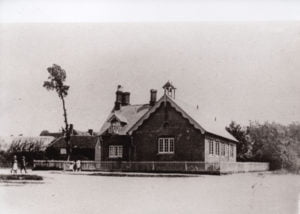
On 20th November 1943, four local farmers driving home from Aylesbury Market were involved in a fatal road accident. Edward Mason Gregory, known as Joe, was driving and his passengers were John Montague Chapman (64) of Red House Farm, Thomas Chapman (67) of Folly Farm and William Newman (66) of College Farm, Gubblecote. Joe Gregory farmed Old Church Farm, at the end of Chapel Lane.
It happened as the car drove into Bierton at around 3pm on a very foggy afternoon with poor visibility. The exact circumstances are a bit of a mystery according to the coroner’s report, but it seems the car crashed into a milk lorry that was heading into Aylesbury. The car was badly damaged, and all four occupants seriously injured. The driver of the lorry, Arthur William Robinson, from Tring, and his passengers were unhurt.
Tragically Thomas Chapman, his cousin John Chapman and William Newman all died in subsequent days and weeks.
Joe Gregory, who we think was 37 at the time, was badly hurt and remained in a coma for a good while after the accident. He was lucky to survive.
These were some of the most important farming families in the village and the impact of the tragedy on the close-knit farming community of Long Marston would have been huge.
On a brighter note, Joe Gregory was eventually nursed back to health by a nurse called Sylvia. And as some of you will remember, Joe and Sylvia later married and had three daughters – Judith, Sarah and Jane.
The full coroner’s report published in the Bucks Herald including interviews with Joe Gregory, Arthur Robinson the driver of the milk lorry and witnesses can be read below.
Bierton Motoring Accident
INQUEST ON THE THREE VICTIMS
BOTH DRIVERS GIVE EVIDENCE
The inquest relating to the motoring accident at Bierton on Saturday November 20th, which robbed the Long Marston district of three well- known and highly respected farmers, was resumed and concluded at the County Hall, Aylesbury, on Thursday of last week. Evidence was given by the drivers of the two vehicles concerned a motor lorry and a private car. The car was driven by Edward Mason Gregory, of Long Marston who had as passengers the three deceased men, John Montague Chapman (64), Red House Farm, Long Marston; Thomas Chapman (67), Folly Farm, Long Marston; and William Newman (66), College Farm, Gubblecote, Long Marston. Messrs. J. M. Chapman and T. Chapman were cousins and the tenants of adjoining farms. The lorry was driven by Arthur William Robinson, of Tring.
Seven witnesses gave evidence, after which the Aylesbury District Coroner, Mr. Stanley E. Wilkins, entered a verdict of “Accidental Death.”
The following representatives were present: Mr. A. J. Walters (Messrs. Parrott & Coales, Aylesbury), for the relatives of the late Mr. J. M. Chapman; Mr. C. M. P. Burgess (Messrs. Thornley & Boutwood, Leighton Buzzard), for the relatives of the late Mr. W. Newman; Mr. R. Leather (Messrs. Leather & Stevenson, Aylesbury), for Mr. E. M. Gregory; and Miss E. Woodforth (Messrs. Horwood & James, Aylesbury), for the driver of the lorry and his employers.
Dr. Richard Henry Martin Robinson, assistant pathologist at the pathology laboratory, Stoke Mandeville Hospital, gave the result of postmortem examinations which he carried out on the bodies of Thomas Chapman and William Newman. He stated that the former died at the Royal Bucks Hospital on Tuesday, November 23rd. There was extensive laceration of the scalp, and the cause of death was, in witness’s opinion, heart failure due to corollary thrombosis. His examination of the body of Mr. Newman, who died in the same hospital on December 27th, showed there was a large abscess on the brain. The cause of death was heart failure due to toxæmia following a brain abscess.
VERY FOGGY AT THE TIME
Leslie Mee Richardson, an aircraft- man in the Royal Air Force stationed in Bucks, said that on the afternoon of Saturday, November 20th, he was given a lift in a milk lorry loaded with churns, which was going to Aylesbury. Two R.A.F. flight sergeants rode on the platform of the vehicle whilst he and a W.A.A.F. sat in front with the driver. It was very foggy at the time and the driver proceeded cautiously. Before Bierton was reached the fog thickened and the driver lowered the window in the off- side door and leaned out to improve his view of the road. Witness, who was sitting by the near-side door of the cab, lowered his window and tried to assist the driver by watching a the near-side grass verge, so that the driver would be sure of keeping to the near-side of the road. The driver watched the white line in the centre of the road and drove about two feet away from the near-side verge. They passed a side lane on the near-side and witness was still watching the grass verge when there was a sudden crash and he saw that a private car had collided with the front offside wing of the lorry. The car finished up in a position facing Aylesbury. It felt as if the lorry driver applied his brakes a fraction before the impact and the vehicle “stopped dead,” with its near-side front wheel close to the left-hand gutter and its rear towards the centre of the road. The rear of the vehicle appeared to slew round to the road centre when the brakes were applied. Witness assisted the W.A.A.F., who was feeling a little upset, to a shop and, when he returned, saw that assistance being rendered to the occupants of the motor car. The front of the car was wrecked. Witness had not seen the car previous to the impact. He noticed that owing to the fog visibility was reduced to about seven yards. He would judge the speed of the lorry as having been in the region of 12 miles per hour at the time of the collision. He did not see the lights of any vehicle coming towards him before the collision. When the lorry driver applied his brakes, they acted satisfactorily. The driver had proper control over the lorry.
INSIDE THE WHITE LINE
The driver of the lorry elected to give evidence, after receiving the customary warning from the coroner, that he was not compelled to do so. He said his name was Arthur William Robinson, that he lived at Pendley Gardens, Tring, and was employed as a motor lorry driver by Messrs. Barnes & Son, of Beaconsfield Road, Tring, at the time of the accident. He stated that about 4 p.m. on the Saturday he was driving a motor lorry loaded with full milk churns, in the direction of Aylesbury. He was familiar with that particular vehicle – and with the road over which he was travelling. He had picked up some passengers and two of them were sitting in the cab with him. As there was a fog he drove leaning out of his vehicle. As he passed through Bierton and approached the cross- roads and Wesleyan Chapel he was driving on the near-side of the road, at about 12 to 15 miles per hour. He had plenty of room in which to control the vehicle, even though he had two passengers in the cab. Whilst taking a slight left-hand bend he was, so far as he could tell, about two feet inside the white line. He was approaching the Wesleyan Chapel (which was on his left) when all of a sudden, he saw a car coming towards him from the direction of Aylesbury. When he first saw the car, it was about 10 or 12 yards away and was travelling in the centre of the road. He did not notice whether it had its lights on or not. He applied both his brakes. They had been adjusted a week previously and operated satisfactorily. He stopped almost “dead” and as he was coming to a standstill the car struck the front of his vehicle on the offside. The car then turned completely round. The impact “jarred” the front of the lorry into the near-side kerb and milk from the churns on the platform, splashed over the cab. He got out of the lorry and approached the offside of the car, which had stopped level with the cab of the lorry. The car driver was lying in the gutter, with his feet in the car, the door having been forced open. There were three men heaped inside the car, huddled together in the centre. The back seat had been forced upwards and was in front of the rear window in the back of the car. Two of the men were lifted out, but the fourth man was left in the car until the arrival of the ambulance. The car was moved slightly before the arrival of the Police. When approaching Bierton, he was only relying on Richardson to tell him if there were any cyclists ahead of the vehicle riding on the near side. Answering a question, witness stated that the car was travelling almost directly in the centre of the road. The sidelights of his lorry were on as he was travelling along.
“A TERRIFIC CRASH “
Fanny Louiza Ashpool, a widow residing at Bennett’s Lane, Rowsham, said that at about four o’clock on the afternoon of November 20th she was standing on the footpath outside the Post Office in Aylesbury Road, Bierton, near to the pillar box, waiting for bus which would take her to Rowsham. It was very foggy at the time; she could just distinguish the Chapel on the opposite side of the road, and that was all. A private car passed her coming from the direction of Aylesbury. It was travelling very slowly-so slowly, that she got the impression that the driver was stopping in order to offer her a lift. But it did not stop and she looked in the Aylesbury direction to see if the bus was coming. She heard a terrific crash and turned round. The car which had just passed had turned completely round in the roadway. The front of the car was pointing towards Aylesbury, whilst the rear was against the pavement on her side of the road. On the other side of the was a motor lorry. She went to the car and saw one of the occupants, a man lying on his back in the roadway, with his feet in the car. She did not see any lights on the car as it came along the road, but it seemed to be travelling pretty near to the kerb. The speed of the car was very slow.
The Rev. William Owen Jordan, of The Manse, Wingrave, stated that he was in Bierton at the time in question. It was very foggy and visibility very poor. He was about to enter the telephone kiosk outside the Post Office and had his hand on the door, when he heard the sound of an impact. Prior to that he had not noticed the noise of any vehicles. He had his back to the roadway, but on turning his head he observed that a car had come into collision with a motor lorry. As he looked, the car was in the act of being slewed round, with its front pointing towards Aylesbury. The lorry was on the other side of the road. A man fell out of the front offside door of the car, head first and on his back. His head struck the ground and his feet remained in the car. He had fallen from the driver’s seat. Witness went immediately to him and pulled him away from the car. There were three more men in the car. One had fallen out on the other side, the second had fallen over him and the third was lying in the back of the car. The man who had fallen out on the other side had apparently been sitting next to the driver. Some person asked if anyone knew first aid. Witness replied that he did and took charge. He instructed those assisting to leave one of the men in the car until the ambulance came. The first injured man was laid in the roadway, near to the kerb, the second man (the one from the seat beside the driver) was laid by him, and the man taken from the back of the car was placed on the pavement. The fourth was left in the car. The first man (the driver of the car) regained consciousness before the arrival of the ambulance and witness gave him a drink of tea.
NO RECOLLECTION OF IMPACT
The driver of the car, Edward Mason Gregory, of Old Church Farm, Long Marston, also elected to give evidence. He said that on Saturday, November 20th, he visited Aylesbury market in his 10 h.p., four-seater, saloon car, taking with him as a passenger the late Mr. William Newman. Witness drove the car out of Aylesbury shortly after three o’clock, in order to return home. He had promised Mr. Newman a lift back, and he also had as passengers the two Mr. Chapmans. Mr. Newman sat by witness in the front and the two Chapmans were on the back seat. The weather conditions were very bad, owing to fog, but witness knew the road well. He could not say whether he had the car lights switched on or not. As far as he remembered, he was travelling on the proper side of the road. He remembered that he was going very slowly and travelling in second gear before reaching Bierton. He did not remember whether he changed into top gear or not. He could remember driving up the hill and entering Bierton, travelling on his correct side of the road, but he could not remember anything that happened after that. He could remember going into Bierton but had no memory of an impact. He was trying to keep to the white line as he came along, but he could not see it very well, as his car was a low one.
Police Constable William Richards stated that at 4.45 p.m. on November 20th he went to the scene of an accident in Aylesbury Road, Bierton, near to the Post Office and on the Aylesbury side of the cross-roads. He observed four injured persons lying on the ground. They had been made comfortable and were taken to the Royal Bucks Hospital on the arrival of ambulances. Two vehicles had been involved in the accident, a 10 h.p. saloon car and a motor lorry. The car was facing the direction of Aylesbury, and the front of the vehicle was completely wrecked.
The lorry was also facing Aylesbury. Its near- side front wheel was one foot from its near-side kerb, and the near-side rear wheel five feet from the kerb. The lorry load was churns full of milk and the milk had poured on to the roadway. There were fresh dirt marks on the roadway, near to the lorry, on the near side of the white line going towards Aylesbury. There was a left- hand bend in the road as the cross- roads were approached from the Wing side, but the approach to the cross- roads from Aylesbury was fairly straight. At the time visibility was very poor witness would estimate it at approximately 30 feet. The road at the scene of the accident was 24 feet wide. As far as witness knew, the car had not been moved when he arrived, but it was moved after measurements had been taken, in order that traffic could pass by.
The Coroner said he was satisfied that the cause of death in the case of each deceased person was as follows: John Montague Chapman, cerebral hæmorrhage following a depressed fracture of the left temple; Thomas Chapman, heart failure due to corollary thrombosis; and William Newman, heart failure due to toxæmia following a brain abscess; and also that the injuries were sustained whilst they were passengers in a car driven by the witness, Edward M. Gregory, at Bierton. He had to decide whether there was any negligence shown by the drivers of the two vehicles, or any third person, So gross as to be criminal negligence. He considered there was no evidence before him of any criminal negligence on the part of either the driver of the lorry or the driver of the car. He therefore entered a verdict that each deceased person accidentally came by his death and not otherwise. The deaths were as a result of the car colliding with the motor lorry. He would like to express sincere sympathy with the relatives of the deceased persons.
Mr. Leather said he would like to associate himself with the coroner’s closing remarks, on behalf of Mr. Gregory